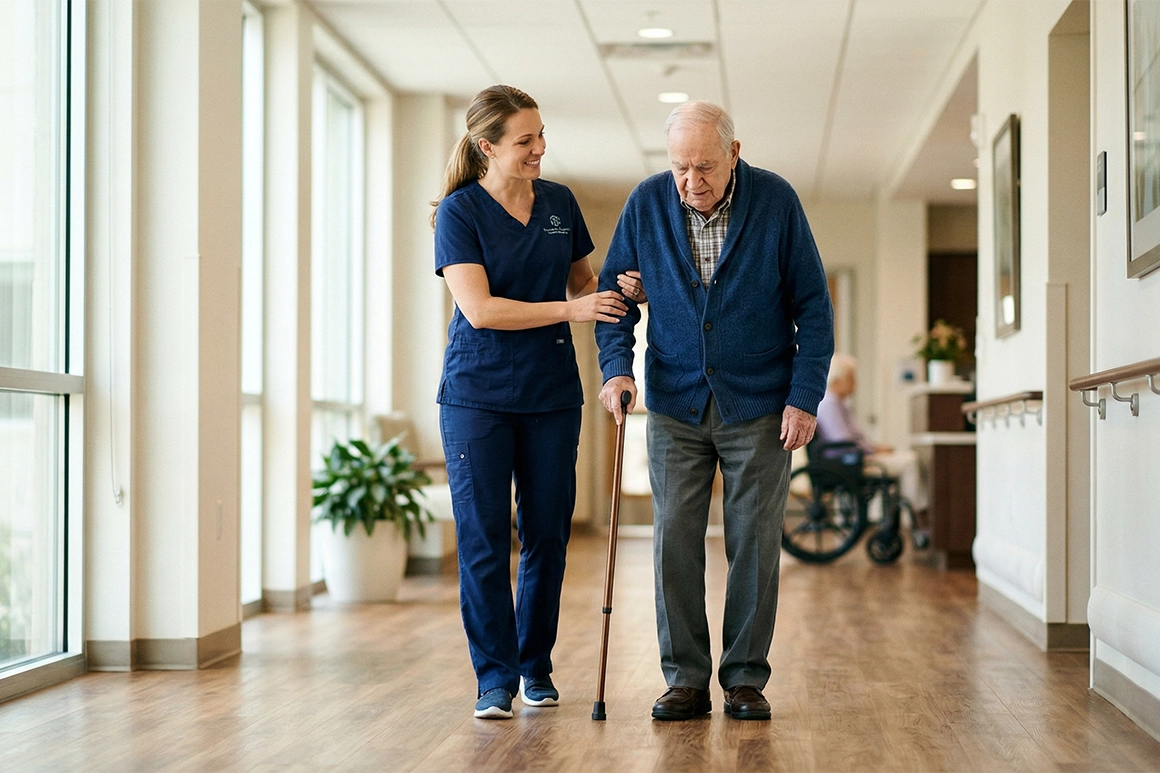
When most people picture a nursing home, the image is familiar and not particularly comforting: long corridors under fluorescent lights, a nurses’ station at the center of everything, meal trays delivered on a schedule, and a faint antiseptic smell that announces, unmistakably, this is a medical facility.
That image is not wrong — it accurately describes the traditional institutional model of senior care that dominated the industry for decades. But it is no longer the only option. And at St. Margaret’s at Mercy, it has never been the goal.
The Household Model of care represents a fundamental rethinking of what senior living can and should be. It asks a simple but radical question: what if we built this around the resident instead of around the institution? The answer, it turns out, changes everything — from the floor plan to the daily schedule to the relationship between staff and the people they serve.
What Is the Household Model?
The Household Model is a person-centered approach to senior care that organizes residents into small, self-contained groups — called “households” — each functioning as its own home within a larger community. Rather than one sprawling facility with a central cafeteria and shared public spaces, the building is divided into intimate neighborhoods, each with its own kitchen, dining room, and living area.
The philosophy behind it is straightforward: people thrive when they feel at home, when their preferences are honored, and when they are surrounded by familiar faces. The model is designed to create exactly those conditions — not as amenities, but as the foundational structure of daily life.
The Core Pillars of the Household Model
Physical Design: A Home, Not a Wing
The most visible difference is architectural. Traditional nursing facilities are built for operational efficiency — long hallways that make it easy to move equipment, centralized services that reduce staffing overhead, shared spaces that serve the largest number of people at once.
Household Model communities are built around a different priority: human scale. Each household typically includes:
- Private or semi-private bedrooms that residents can personalize as their own space
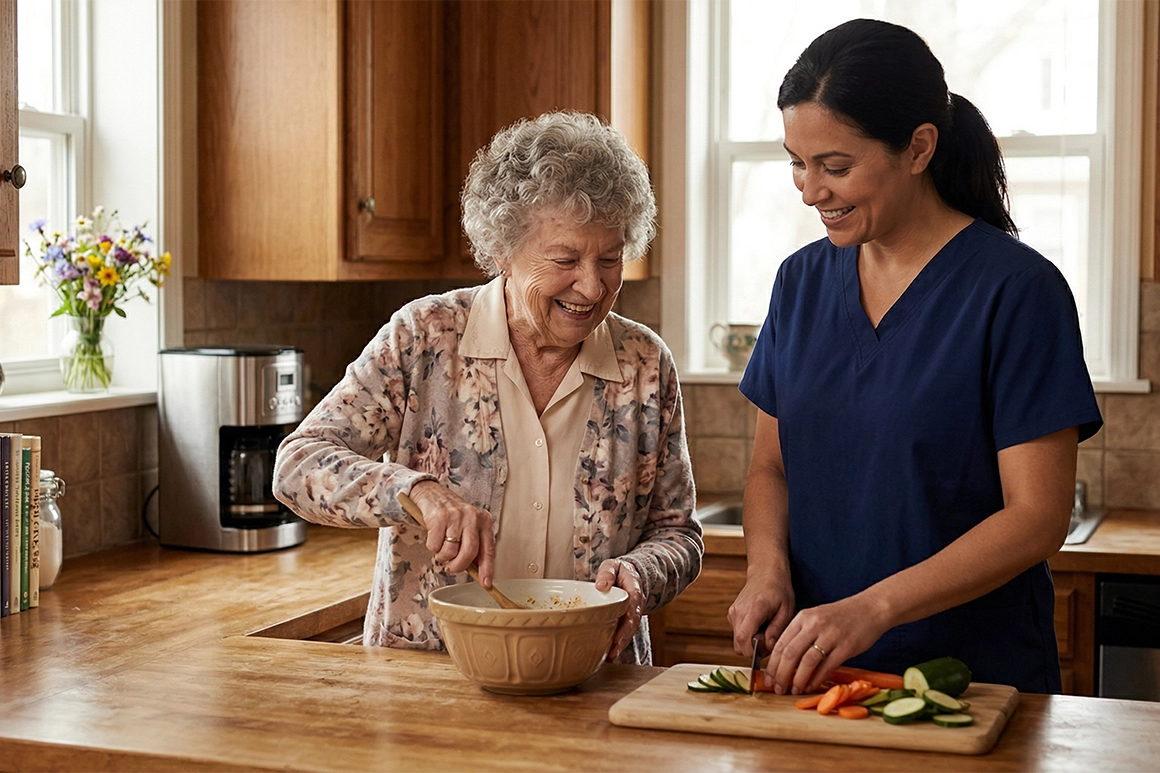
- A shared kitchen at the heart of the household, where meals are prepared and the rhythms of a real home play out
- A dining area where residents eat together at a table, not a cafeteria
- A living room — not a lobby or a lounge, but a genuine gathering space that belongs to that specific group of residents
The difference in feel is immediate. Smaller spaces are quieter, more navigable, and more familiar. They feel less like a facility and more like the kind of home people actually want to live in.
Autonomy and Choice: The Day Belongs to the Resident
In a traditional institutional model, the schedule belongs to the institution. Breakfast is at 7:30. Medications are distributed at 8:00. Activities begin at 10:00. The facility’s operational needs set the rhythm, and residents adapt to it.
The Household Model inverts this. Residents decide when they wake up. They decide what they want to eat for breakfast and when they want it. They choose how to spend their afternoon — whether that means joining an activity, sitting in the garden, watching television, or simply resting. These may seem like small freedoms, but for someone who has spent a lifetime making their own decisions, the ability to continue doing so is not a small thing. It is dignity, maintained.
Consistent Staffing: The Same Faces, Every Day
In large institutional settings, staff rotation is frequent and often unavoidable. Residents may interact with a different caregiver each day, and no single staff member has the opportunity to truly know the people they care for.
The Household Model is built around consistency. The same caregivers work in the same household, with the same residents, day after day. Over time, these relationships deepen into something that genuinely resembles family. A caregiver who sees the same resident every morning learns her preferences, notices when something is off, and provides care that is informed by real knowledge of that person — not just a chart.
For residents, this means never having to re-explain themselves to a stranger. For families, it means the people caring for their loved one actually know their loved one.
Household Model vs. Traditional Nursing Home Care
The contrast becomes clearest in the details of daily life.
In a traditional facility, meals arrive from a central kitchen on trays, portioned and scheduled. In a Household Model community, meals are prepared in the household’s own kitchen. The smell of coffee in the morning, bread baking in the afternoon — these sensory cues are not incidental. For residents, particularly those living with dementia, familiar smells trigger appetite, memory, and a sense of wellbeing that a cafeteria tray simply cannot replicate.
In a traditional facility, medication distribution can feel impersonal — a cart moved from room to room, a routine that resembles an assembly line more than a care interaction. In the Household Model, medication management is handled discreetly and personally, within the context of a relationship between caregiver and resident.
In a traditional facility, common areas often feel like hotel lobbies — designed to accommodate many people at once but belonging to no one in particular. In the Household Model, the living room belongs to the household. It is their space, and the socialization that happens there is genuine rather than programmatic.
The Benefits: What the Research Shows
The shift from institutional to person-centered care is not simply a matter of aesthetics or philosophy. The outcomes are measurable.
For residents living with dementia and memory care needs, smaller environments are less overstimulating and significantly easier to navigate. The reduction in ambient noise, unfamiliar faces, and disorienting institutional cues leads to decreased agitation and, in many cases, reduced episodes of “sundowning” — the increased confusion and distress that often occurs in the late afternoon and evening hours.
For overall health and wellbeing, studies on person-centered care models consistently show improvements in appetite and nutritional intake, better sleep patterns, and reduced feelings of isolation and depression. When people feel at home, they eat better, sleep better, and engage more fully with the life around them.
For families, the difference is often described in emotional terms. There is a particular kind of grief that accompanies placing a loved one in a facility that feels like a facility — the guilt of institutional care, as it is sometimes called. Seeing a parent or spouse settled in a living room rather than a hospital wing, known by name by the people who care for them daily, changes that experience in a meaningful way. It does not eliminate the difficulty of the transition, but it replaces dread with something closer to reassurance.
How St. Margaret’s at Mercy Lives the Model
St. Margaret’s has been serving New Orleans families since 1889 — a legacy long enough to have witnessed every evolution in senior care, and a commitment deep enough to have embraced the one that actually centers the resident.
A Staff Culture Built Around Relationship
The Household Model only works if the culture supports it. At St. Margaret’s, caregivers are not simply task-performers moving through a checklist. They are encouraged to sit with residents, to have conversations, to know the stories behind the faces. A caregiver who knows that a resident spent her career as a schoolteacher, or that another grew up in the Tremé neighborhood, brings a fundamentally different quality of presence to her work — and residents feel that difference every day.
The Neighborhood Beyond the Household
Each household at St. Margaret’s is its own intimate home, but the community surrounding those households offers the warmth of a New Orleans neighborhood. The on-site chapel provides a place for reflection and spiritual life. The salon offers the simple, restorative pleasure of being looked after. The gardens provide outdoor space that belongs to residents — to sit in, to tend, to simply exist in.
These spaces function as the neighborhood surrounding each household: places to venture out to, to encounter other residents, to participate in the larger life of the community.
Community Life That Feels Like Community
Birthdays at St. Margaret’s are not institutional acknowledgments. They are celebrations — gathered in the multi-purpose room with the people who know the resident, who have shared meals and afternoons and conversations with them. Club meetings, holiday gatherings, and community events are organized not as scheduled programming but as the kind of occasion a neighborhood actually produces: something to look forward to, something to belong to.
This is the New Orleans way of caring for people. It has always been, at its core, about showing up for family.
Is the Household Model Right for Your Loved One?
The Household Model is not the right fit for every senior care need — but it is the right fit for more people than the traditional institutional model ever served well.
It is particularly well-suited for:
- Seniors who value independence and routine — those for whom the ability to make their own choices about daily life is not a preference but a fundamental part of who they are
- Those living with dementia or Alzheimer’s disease — for whom smaller, calmer, more predictable environments measurably reduce confusion, agitation, and distress
- Residents prone to anxiety in large or unfamiliar spaces — who flourish when the environment is human-scaled and the faces around them are consistent
- Families seeking a more personal standard of care — who want to know that their loved one is genuinely known, not just adequately managed
If the people in your family have always taken care of each other — if the table has always been the center of things, and showing up has always mattered — then the Household Model will feel familiar in the best possible way.
The Household Model Is About Dignity
The physical design matters. The staffing model matters. The meal preparation and the living rooms and the consistent caregivers all matter.
But beneath all of it is something simpler: the belief that a person does not stop being a person because they need help. That the way we care for our most vulnerable community members says something about who we are. That a home — even one that provides skilled nursing care, even one where someone will spend the last years of their life — should feel like a place where a person belongs.
At St. Margaret’s at Mercy, that belief has guided our work for over 130 years. The Household Model gave it a name. We had already been living it.
Want to see the Household Model in action? Schedule a tour of St. Margaret’s at Mercy and experience the difference between a facility and a home. Our team is ready to answer your questions and help you find the right level of care for your loved one.